












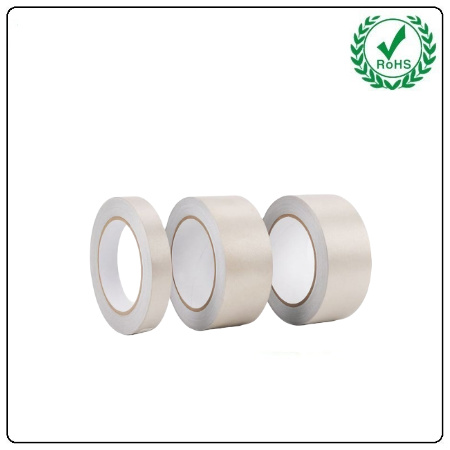
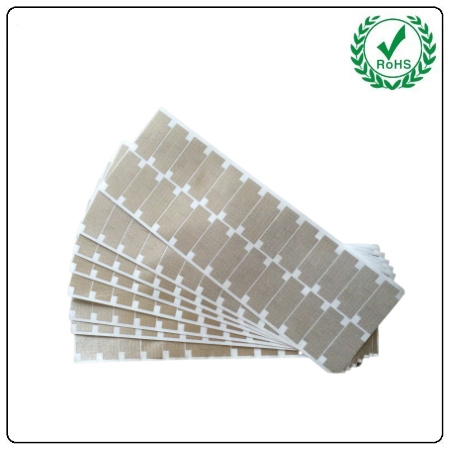
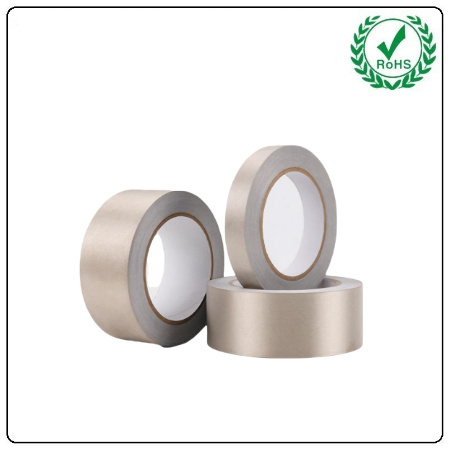
Emi Conductive Fabric
${{shopModel.rebate>0?shopModel.discountPriceStr:shopModel.formattedAmount}}
$ {{shopModel.formattedAmount}}
Like
{{item.name}}
Quantity:
Estimated Delivery Date: Oct 20-Oct 20
Frequently Asked Questions
How can I contact customer service?
Do you ship overseas?
How long will it take to get my order?
Specifications
{{item.name}}
{{item.value}}
With the advancement of 5G, artificial intelligence, and IoT technologies, electromagnetic interference scenarios have become more complex and shielding requirements more stringent. EMI shielding gaskets are evolving toward ultra-thin and lightweight designs, while EMI conductive fabrics are being optimized for high abrasion resistance and broad-frequency shielding. Together, they form the core foundation for ensuring compliant operation and enhanced performance in electronic devices.
Based on differences in coating materials and structures, EMI conductive fabrics are primarily categorized into the following four types:
| Type | Core Plating Structure | Key Characteristics | Applicable Scenarios |
| Nickel-Plated Conductive Fabric | Polyester Fiber Cloth + Pure Nickel Plating | Shielding effectiveness: 60-80dB, strong corrosion resistance, moderate cost, excellent flexibility | Lining of general electronic devices, anti-static gloves, shielding curtains |
| Nickel-Copper-Nickel Plated Conductive Fabric | Polyester Fiber Cloth + Nickel/Copper/Nickel Triple Plating | Shielding effectiveness: 80-95dB, high conductivity, wear resistance up to 5 million cycles, optimal comprehensive performance | Shielding components for high-end electronic devices, base material of conductive fabric gaskets, lining of medical equipment |
| Carbon-Plated Conductive Fabric | Polyester Fiber Cloth + Conductive Carbon Layer | Shielding effectiveness: 50-70dB, low cost, good concealment with black appearance | Civilian anti-radiation products, shielding lining for low-interference scenarios |
| Aluminum Foil Fiber Composite Cloth | Polyester Fiber Cloth + Aluminum Foil Composite Layer | Shielding effectiveness: ≥90dB, good thermal conductivity, high mechanical strength | Shielding room walls, shielding of industrial equipment enclosures, lining of base station cabinets |
EMI conductive fabric offers flexible application forms, primarily categorized into two types that highly overlap with EMI shielding gasket scenarios:
1. As standalone shielding components: Directly cut into corresponding shapes for internal shielding partitions in electronic devices, shielding room curtains, radiation-proof workwear, etc. Its flexibility adapts to irregular structures while providing excellent electrostatic discharge (ESD) protection.
2. As a core material for gaskets: Wrapped around a high-elasticity foam core to form conductive fabric pads, integrating both shielding and cushioning functions. This constitutes a key branch of EMI shielding gaskets, widely applied in electronic chassis seams, laptop bezels, mobile device interfaces, and similar locations, simultaneously achieving gap sealing and interference blocking.
CUSTOMER REVIEWS
{{commentStat.averageRating}}
{{commentStat.total}} Revirews
All({{commentStat.total}})
Images({{commentStat.imgSum}})
5 Star({{commentStat.praiseSum}})



{{item.comments}}